


Best overall: Miles Davis's Kind of Blue. Best for unusual rhythms: The Dave Brubeck Quartet's Time Out. Best for funk-oriented listening: Herbie Hancock's Head Hunters. This 2026 guide compares five jazz vinyl records by musical style and explains which edition details to verify before buying.
- Miles Davis's Kind of Blue is the default first choice among jazz vinyl records for a broad collection.
- Choose John Coltrane's Blue Train for hard bop or A Love Supreme for a connected suite.
- The Dave Brubeck Quartet's Time Out suits rhythm-focused listeners; Herbie Hancock's Head Hunters suits jazz-funk collectors.
- Compare vinyl editions by catalog number, track list, disc count, and documented mastering—not cover art alone.
For Mediamall shoppers choosing jazz vinyl records, Miles Davis's Kind of Blue is the default first album. The recommendations below identify recordings, not particular pressings; an album recommendation does not establish the specifications of every edition carrying its title.
Why this matters
Buying a jazz album and choosing a vinyl edition are separate decisions. Start with the music you want, then confirm that the listing describes the exact physical release you intend to receive.
That distinction matters when comparing an individual LP, a retailer-assembled artist bundle, and a label-issued box set. A bundle groups products for purchase; a box set is a particular release whose included recordings, packaging, and extras need their own verification.
For a 2026 purchase, use this order: choose the recording, identify the edition, check the contents, and compare it with records you already own. A famous title alone does not tell you the pressing, mastering source, or included extras.
What makes the best jazz vinyl records?
These recommendations prioritize musical fit over collectible packaging. Use the same criteria when deciding whether an album belongs in your collection:
- Listening style: Separate acoustic small-group jazz, hard bop, extended suites, and electric jazz-funk. Choose the sound you actually want to hear.
- Album structure: Decide whether you prefer distinct selections or a connected work intended for listening in sequence.
- Collection fit: Add a different artist, ensemble, or musical approach rather than buying another edition without a reason.
- Edition identity: Match the artist, album title, label, and catalog number. Similar covers do not establish identical releases.
- Verified contents: Confirm the track list, format, included discs, and any explicitly listed extras before purchasing.
- Playback requirements: Check the stated speed and side configuration. Do not infer them from the album's original configuration.
The best record is the album you want in an edition you can identify. A heavyweight disc, colored pressing, or elaborate package does not replace those checks.
Jazz vinyl records at a glance: 2026 picks
| Recording | Best for | Standout musical feature | Key limitation |
|---|---|---|---|
| Miles Davis — Kind of Blue | A first acoustic jazz album | Modal improvisation with contrasting horn and piano voices | Not an introduction to electric jazz or vocal jazz |
| The Dave Brubeck Quartet — Time Out | Rhythm-focused listening | Compositions using unusual meters, including Take Five | Less suitable if you want loose, open-ended ensemble playing |
| John Coltrane — Blue Train | Hard-bop arrangements | A three-horn front line with distinct ensemble passages and solos | Not representative of Coltrane's later exploratory direction |
| John Coltrane — A Love Supreme | A connected album-length statement | A four-part suite performed by Coltrane's quartet | Less suitable for listeners seeking unrelated, self-contained selections |
| Herbie Hancock — Head Hunters | Electric jazz-funk | Keyboard-led grooves with bass, drums, percussion, and reeds | Not an acoustic piano-trio recording |
The table ranks recordings by distinct uses, not pressing quality. None of these album names, by itself, establishes whether a specific copy is mono, stereo, newly mastered, or supplied with additional material.
1. Miles Davis — Kind of Blue: best jazz vinyl records starter
Miles Davis's Kind of Blue is the first recommendation if you want an acoustic jazz album without committing immediately to a narrower style. Its modal approach leaves room for contrasting improvisations rather than making every selection depend on rapid chord changes.
The standard album program contains 5 tracks. Treat that as a reference for identifying the core recording, not proof of the contents or disc count of an expanded edition.
Kind of Blue pros:
- Contrasting trumpet, saxophone, and piano voices give you several instrumental approaches to follow.
- Distinct selections make it straightforward to revisit individual performances.
- The acoustic setting provides a useful starting point before exploring electric jazz or more abstract work.
Kind of Blue cons:
- It does not cover vocal jazz, big-band arranging, or electric fusion.
- Buying another edition adds no new repertoire unless its documented contents differ.
Edition check: Confirm the complete track list and whether the listing specifies mono or stereo. If the seller identifies mastering or source details, match those statements to the exact edition rather than transferring them from another release.
Best for: Collectors choosing their first acoustic jazz album or filling a central gap in an existing collection.
Verdict: Buy Kind of Blue as the default starting recording; choose the pressing separately.
2. The Dave Brubeck Quartet — Time Out: best for rhythm-focused listening
The Dave Brubeck Quartet's Time Out makes rhythmic structure the main reason to choose it. Take Five uses 5/4 time, while Blue Rondo à la Turk uses 9/8 time; those are musical meters, not playback instructions.
Choose Time Out when you want to follow the relationship between recurring rhythms, composed themes, and improvisation. Its piano-and-alto-saxophone setting also offers a different ensemble balance from the horn-led recordings elsewhere in this guide.
Time Out pros:
- Unusual meters give the album a clear musical identity.
- Recognizable themes provide reference points as the musicians improvise.
- The quartet format makes individual instrumental roles easy to follow.
Time Out cons:
- Its composed structures are not the best fit for someone seeking free-form improvisation.
- It does not provide the larger horn arrangements found on Blue Train.
Edition check: Distinguish the original album program from editions that add other recordings. Check whether extra material appears on the same disc or on additional discs; an expanded title does not explain the physical configuration.
Best for: Listeners interested in meter, rhythmic patterns, and a clearly defined acoustic quartet sound.
Verdict: Buy Time Out for rhythmic contrast, not as a substitute for every other jazz style.
3. John Coltrane — Blue Train: best for hard-bop arrangements
John Coltrane's Blue Train combines composed horn passages with extended solo space. Its front line brings together tenor saxophone, trumpet, and trombone, giving the ensemble a different sound from Coltrane's quartet recordings.
Choose Blue Train if you want arranged themes and individual improvisation in the same album. It is also the more direct choice here for someone specifically seeking hard bop rather than Coltrane's later suite-based work.
Blue Train pros:
- The three-horn lineup provides a clear reason to add it beside a smaller-group album.
- Ensemble passages and solos create distinct listening sections.
- It offers a focused introduction to Coltrane in a hard-bop setting.
Blue Train cons:
- It does not represent the full range of Coltrane's later music.
- Its acoustic arrangements do not meet a preference for electric keyboards or funk rhythms.
Edition check: Confirm whether the listing describes the core album or an edition with alternate takes. If alternate material matters to you, compare the actual track names rather than relying on words such as expanded or deluxe.
Best for: Collectors who want horn arrangements, hard-bop themes, and solo-led performances.
Verdict: Buy Blue Train for hard bop; skip it as a stand-in for Coltrane's later direction.
4. John Coltrane — A Love Supreme: best for a connected suite
John Coltrane's A Love Supreme is the choice for listening to a work in sequence. Its 4 parts are Acknowledgement, Resolution, Pursuance, and Psalm, performed by Coltrane's quartet with McCoy Tyner, Jimmy Garrison, and Elvin Jones.
Unlike a collection of unrelated selections, the suite gives you a reason to follow the whole program. Choose it because you want that structure, not simply because you recognize Coltrane's name.
A Love Supreme pros:
- The connected structure supports full-album listening.
- A consistent quartet gives the suite a defined instrumental identity.
- It adds a different Coltrane setting alongside the larger ensemble on Blue Train.
A Love Supreme cons:
- It is less suitable for someone seeking a collection of independent standards.
- Its concentrated improvisational approach is not the same listening proposition as a groove-led electric album.
Edition check: Separate the studio suite from live performances and session material. A listing with the same central title can describe a different program, so read the complete subtitle and track list.
Best for: Collectors who listen in sequence and want a connected quartet performance.
Verdict: Buy A Love Supreme for the complete suite; verify which performance the edition contains.
5. Herbie Hancock — Head Hunters: best for electric jazz-funk
Herbie Hancock's Head Hunters is the most direct choice here for electric keyboards and funk-oriented grooves. It shifts the comparison away from the acoustic horn-and-piano settings of the other recommendations.
The core album contains 4 tracks. Chameleon and Watermelon Man are useful starting points for deciding whether its electric ensemble belongs in your collection.
Head Hunters pros:
- Electric keyboards make it a distinct addition to an acoustic-heavy shelf.
- Repeating grooves give you a different framework for following improvisation.
- Bass, drums, and percussion are central to the album's musical character.
Head Hunters cons:
- It is the wrong choice if you specifically want acoustic piano jazz.
- Extended groove-based performances do not replace a collection of shorter standards.
Edition check: Confirm the album title and track list before comparing physical specifications. Do not assume that every pressing uses the same disc layout or that an edition's weight establishes its mastering source.
Best for: Listeners moving from funk into jazz or adding electric jazz to an acoustic collection.
Verdict: Buy Head Hunters for electric jazz-funk; skip it when acoustic instrumentation is the requirement.
How to choose the exact vinyl edition
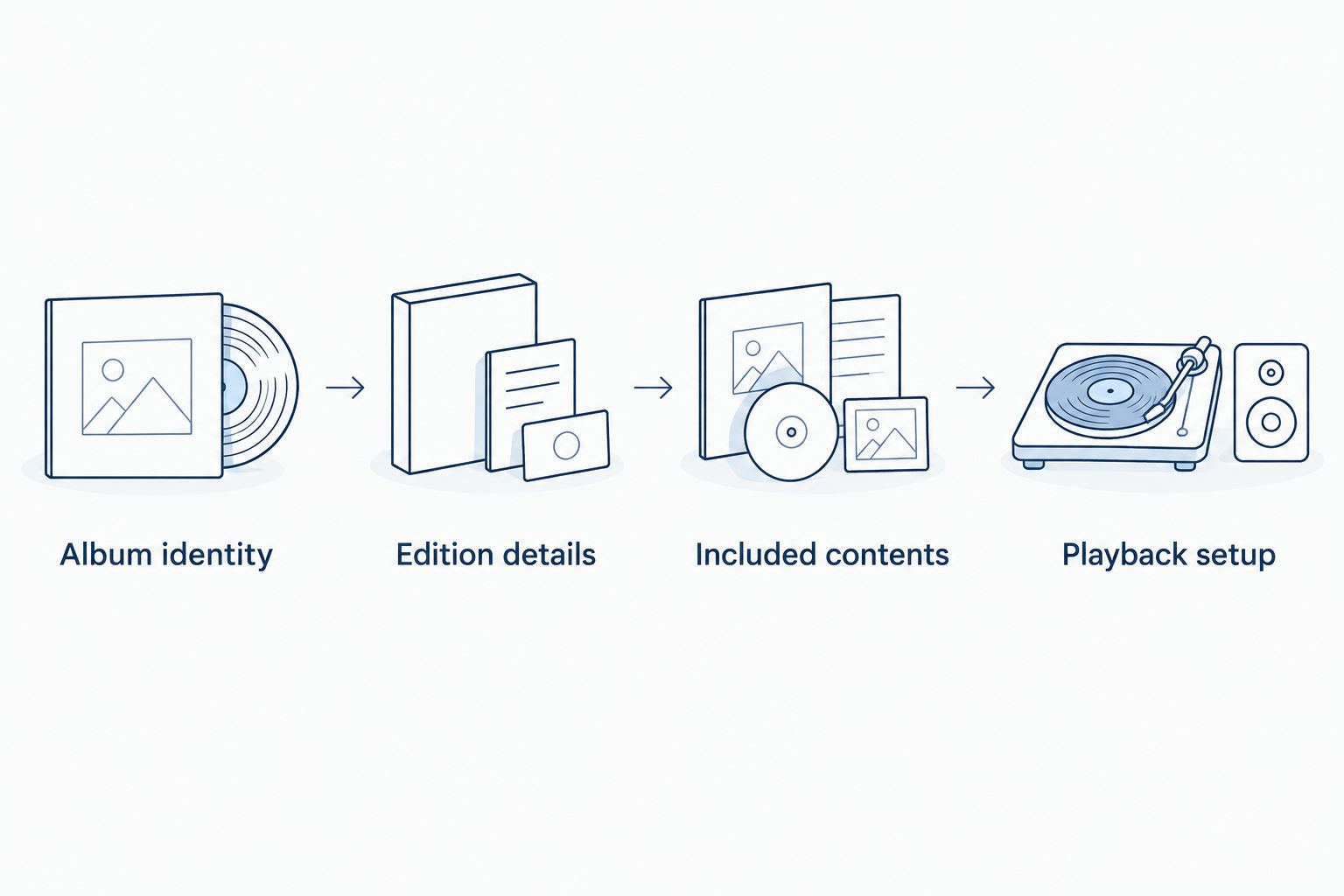
Use these checks for any 2026 jazz vinyl purchase. They separate the musical recommendation from the physical product you are ordering.
- Album identity: Match the artist, full title, and program. Watch for live versions, similarly titled releases, and compilations.
- Edition details: Record the label and catalog number. Confirm any stated mono, stereo, mastering, or pressing information against that edition.
- Included contents: Read the track list and verify the number of discs, additional recordings, inserts, and other explicitly listed extras.
- Playback setup: Check the specified speed and side layout. A release cut at 45 rpm requires a different setting from one cut at 33⅓ rpm.
Do not treat 180 g vinyl as a mastering specification. That figure describes record weight; it does not identify the audio source, cutting engineer, or condition of an individual copy.
When a detail determines your purchase, require an explicit statement rather than filling the gap from a photograph. This is especially important when comparing editions that share the same cover artwork.
Artist bundle or label-issued box set?
A retailer-assembled artist bundle groups separate albums into one purchase. A label-issued box set is a defined release with its own documented contents; neither description automatically promises bonus recordings, matching pressings, or special packaging.
For Mediamall purchases, compare the included album names before treating a bundle as a collection upgrade. Then check each album's edition details rather than assuming the entire group shares one pressing specification.
A bundle is useful when you want its included albums. Skip duplication unless a particular edition supplies a documented difference you actually want.
How the recordings are ranked
This 2026 ranking prioritizes distinct listening needs: an acoustic starting point, unusual meters, hard-bop arrangements, a connected suite, and electric jazz-funk. It does not rank individual pressings or claim comparative listening tests.
Kind of Blue takes the default slot because its acoustic ensemble and distinct selections provide a broad starting point. Each remaining recommendation earns its place by offering a different musical reason to buy, not by repeating that same role.
Which jazz vinyl records should you choose?
Choose Kind of Blue if you are undecided. Move to Time Out for rhythmic structures, Blue Train for horn arrangements, A Love Supreme for a connected suite, or Head Hunters for electric grooves.
For Mediamall jazz vinyl records shoppers building beyond a first album, add a contrasting musical approach before buying another copy of something already owned. A different recording expands your repertoire; a different pressing needs a separate, edition-specific reason.
FAQ
What's the best jazz vinyl record to buy first?
Miles Davis's Kind of Blue is the default first recommendation in this guide. Choose it for acoustic ensemble playing, then verify the exact vinyl edition before ordering.
Is Blue Train better than A Love Supreme for a new collector?
Choose Blue Train for hard-bop horn arrangements and A Love Supreme for a connected quartet suite. The better purchase depends on the musical structure you want, not simply the shared artist name.
Which jazz vinyl record should I choose if I like funk?
Herbie Hancock's Head Hunters is the funk-oriented recommendation in this guide. Its electric keyboards and groove-centered ensemble distinguish it from the acoustic albums listed here.
Does 180 g vinyl guarantee better sound?
No, 180 g specifies record weight rather than mastering quality. Check documented source and mastering information separately, and assess the condition of the individual copy.
Is an artist vinyl bundle the same as a box set?
No, a retailer-assembled artist bundle groups albums for purchase, while a label-issued box set is a defined release. Verify the included albums, discs, and extras rather than assuming either format includes special material.
How do I avoid buying the wrong jazz vinyl edition?
Match the artist, album title, label, catalog number, and track list before ordering. Then confirm the disc count, playback speed, and any edition-specific details that matter to your purchase.
One last thing
For your final 2026 purchase check, compare the track list before the packaging. An alternate take is a different performance of a composition, not automatically an additional composition, and a live version is not the studio recording.
Buy the program you want, then the edition you can verify. That rule is more useful than choosing a record by weight, color, or an unexplained collector label.