


Best overall: a newly issued prerecorded cassette of an album you already know. Best for collecting an older edition: a play-tested used album; best for artist discovery: a greatest-hits cassette; best for film-music collectors: a soundtrack cassette. This 2026 guide ranks buying approaches, with edition and condition checks to apply before choosing a specific release.
- For cassette tapes music purchases, start with a familiar album and an explicitly identified cassette edition.
- Choose play-tested used cassettes for older editions; inspect the tape and packaging separately.
- Greatest-hits cassettes suit artist discovery; soundtrack cassettes suit buyers seeking a specific film’s music.
- Mediamall sells physical music formats; confirm cassette format on the individual listing before choosing an edition.
Why this matters
Buying an album and buying the right cassette edition are different decisions. The artist and title identify the music, but the format, track list, catalog number, packaging, and playback condition identify what you receive.
Mediamall sells cassettes alongside vinyl records, CDs, and other physical media. Keep those formats separate when browsing: an album title alone does not establish that a listing is for a cassette.
For a first purchase in 2026, prioritize a release you want to play over an unfamiliar edition with collectible wording. A familiar album gives you a useful listening reference, not proof that a tape is fault-free.
What makes the best cassette tapes for new collectors?
Use these criteria before comparing artwork or edition labels:
- Music fit: Choose an album, artist overview, or soundtrack you actually want to hear in sequence.
- Format certainty: Require an explicit cassette designation. Vinyl, CD, and digital editions are not substitutes.
- Edition identity: Match the artist, title, label, catalog number, and track list where provided.
- Playback evidence: Separate an unopened claim, a visual inspection, and a documented playback check.
- Packaging completeness: Check the cassette, case, and printed insert individually rather than treating them as one condition grade.
- Player readiness: Confirm that you have a working cassette player before building a collection around the format.
These checks favor clear listings over elaborate descriptions. Neither an attractive shell nor a collectible label tells you whether a used tape plays correctly.
Best cassette choices at a glance
| Rank and option | Best for | Standout feature | Key limitation |
|---|---|---|---|
| 1. Newly issued prerecorded album | Your first listening copy | Familiar music in a clearly identified edition | New condition does not establish mastering or playback quality |
| 2. Play-tested used album | Collecting an older edition | A specific release with documented playback evidence | Playback testing does not establish storage history |
| 3. Prerecorded greatest-hits cassette | Exploring one artist | A track list spanning selected songs | It is not a substitute for the original albums |
| 4. Prerecorded soundtrack cassette | Collecting music from a film | A release tied to a specific film title | A soundtrack can contain songs, a score, or a selection of either |
The ranking separates four buying goals. A soundtrack belongs first on your personal list if film music is your reason for collecting; the overall recommendation is for someone starting without a specific edition target.
1. Newly issued prerecorded album: best cassette for a first listening copy
A newly issued prerecorded album is the simplest starting point when the listing identifies the cassette format and the included music. Choose an album you know rather than making your first purchase both an unfamiliar recording and an unfamiliar format.
A current issue is not automatically an original edition, and a reissue is not automatically remastered. Read those as separate claims requiring separate details.
Newly issued album pros:
- Familiar songs help you notice unexpected changes in pitch or playback speed.
- An identified edition gives you a clear reference for checking the package.
- A single album keeps your first purchase focused on music you intend to play.
Newly issued album cons:
- New condition does not guarantee fault-free playback.
- The listing must still establish the track list and edition.
- Packaging alone cannot establish the source or mastering used.
Best for: A beginner who wants a regular listening copy rather than a particular historical issue.
For a 2026 purchase, read the description for format and contents before interpreting release dates or promotional language. Compare the printed title with the listing, and check whether any bonus material is explicitly named. Do not transfer details from a vinyl or CD edition to its cassette counterpart.
Verdict: Buy when the cassette edition is explicit, the contents match your intended album, and your player is ready.
2. Play-tested used album: best cassette for an older edition
A used cassette suits a collector seeking a particular release, packaging version, or older album edition. The useful distinction is not simply used versus new; it is whether the listing explains the condition of the actual copy.
Look for playback information that describes what was checked. A seller’s statement that a cassette was inspected visually is not the same as a statement that both sides were played.
Play-tested used album pros:
- Lets you target a specific older edition rather than a current counterpart.
- Copy-specific photographs support checks of the shell, insert, and catalog number.
- A described playback check provides more evidence than appearance alone.
Play-tested used album cons:
- A playback check does not establish the tape’s storage history.
- A clean case can contain a worn or damaged cassette.
- Original packaging and a replacement case are different collecting considerations.
Best for: A collector who cares about a specific edition and will inspect condition details carefully.
Treat condition as several separate questions. Is the shell cracked? Is the tape visibly creased or loose? Is the printed insert present? Does the playback description mention speed variation, dropouts, or stopping?
For an older cassette bought in 2026, age alone is not a condition grade. Do not accept either an automatic rejection or an automatic endorsement based only on a release date.
Verdict: Buy when the edition matches your goal and the copy has useful playback evidence; hold when the description covers appearance only.
3. Prerecorded greatest-hits cassette: best for exploring an artist
A greatest-hits cassette gives you a selected introduction to an artist rather than a complete studio album. Choose it by the actual track list, not by assuming that every release with a similar title contains the same songs.
This approach works when you recognize individual tracks but have not chosen an album. It is less suitable when your goal is to hear an original album in its intended sequence.
Greatest-hits cassette pros:
- Lets you choose a release around songs you already recognize.
- Provides a defined selection without committing to an album collection.
- Makes track-list comparison central to the purchase.
Greatest-hits cassette cons:
- Selected songs do not represent every period of an artist’s work.
- Alternate versions and edits require checking the edition’s credits.
- A compilation can duplicate music you already own.
Best for: A listener exploring one artist through recognizable songs.
Write down the tracks that matter to you before comparing editions. Then check whether the cassette identifies studio recordings, live performances, edits, or rerecordings. Do not assume a compilation includes a particular recording merely because the song title matches.
A compilation is also not an album bundle. A retailer-assembled bundle groups separately identified releases; a label-issued box set is a defined release with its own stated contents. Neither description establishes that the included format is cassette.
Verdict: Buy when the listed songs and versions match your listening goal; skip when you really want a specific studio album.
4. Prerecorded soundtrack cassette: best for film-music collectors
A soundtrack cassette connects a music purchase to a specific film. Establish whether the release contains featured songs, an instrumental score, or another defined selection before treating the film title as enough information.
The title on the cover does not guarantee that every piece heard in the film appears on the cassette. Use the track list and credited performers or composer to identify the release.
Soundtrack cassette pros:
- Gives film collectors a specific title to organize a purchase around.
- A credited track list distinguishes songs from an instrumental score.
- Packaging and music can serve the same collecting interest.
Soundtrack cassette cons:
- The release need not include every musical cue from the film.
- Different editions require separate track-list checks.
- Similar film titles or sequel names can lead to the wrong purchase.
Best for: A collector who wants a particular film’s songs or score on cassette.
Before choosing, identify the recording you want by composer, artist, or track title. Compare that information with the cassette listing instead of carrying over assumptions from another format. Mediamall sells both music and movies, so distinguish an audio soundtrack from a DVD of the film.
Verdict: Buy when the music credits and track list match your target; hold when the listing provides only a film title.
Check the player before judging the tape
A cassette and its player form a playback system. Speed instability, dirty playback components, and tape damage can all affect what you hear, so a disappointing first listen does not identify the cause by itself.
Standard compact cassettes run at approximately 4.76 centimeters per second. Incorrect playback speed changes both timing and pitch; familiar music helps you recognize that something needs investigation.
Use this order before expanding your collection:
- Check the player: Follow the equipment manufacturer’s operating and maintenance instructions.
- Inspect the cassette: Look for shell damage, exposed tape, and obvious deformation.
- Confirm settings: Match tape-type and noise-reduction settings to the recording information and player instructions.
- Listen through: Assess both sides rather than only the opening track.
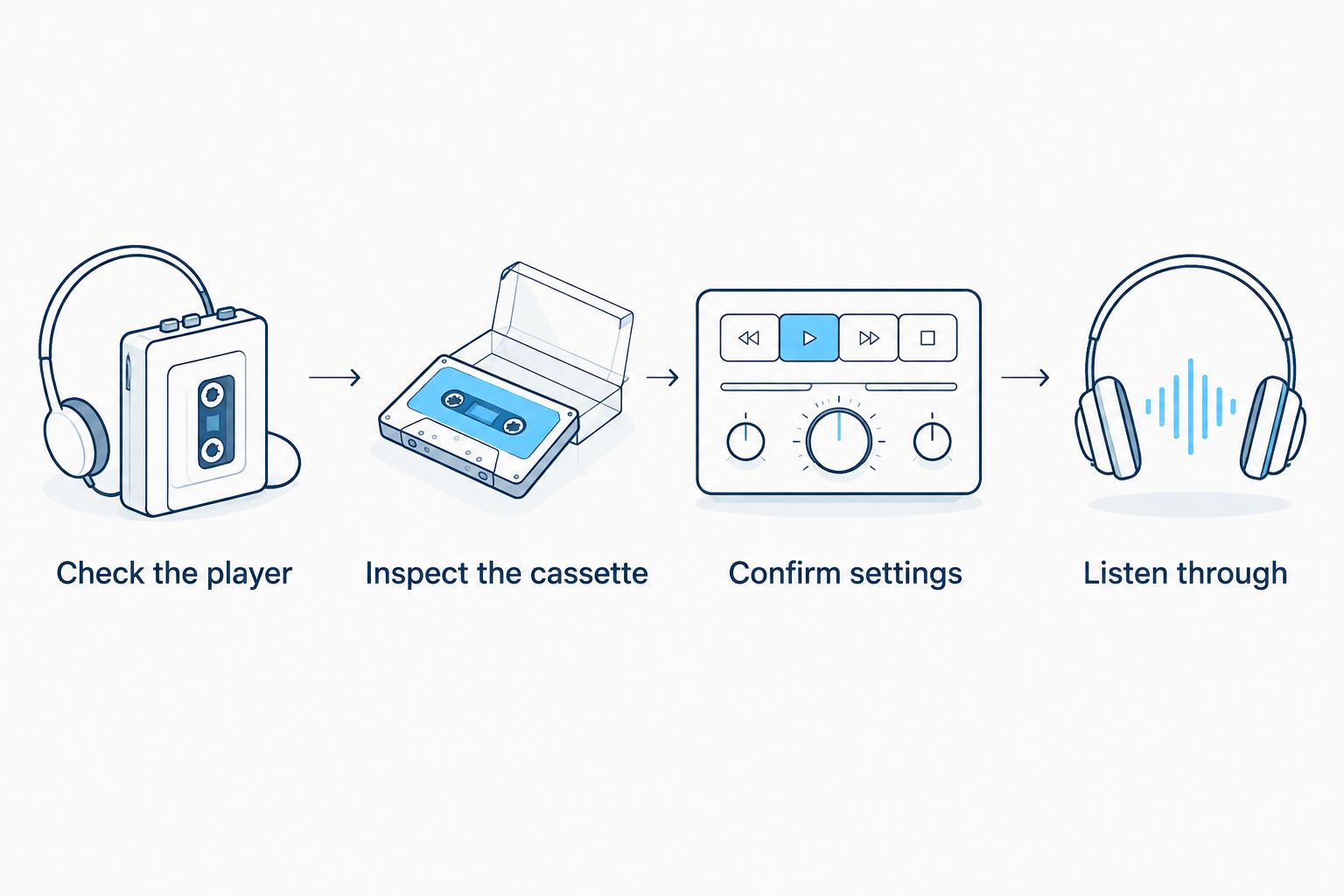
Stop playback if the tape stops moving properly or begins spilling from the shell. Do not keep replaying a damaged section to see whether it improves.
Prerecorded music versus blank recording tape
Prerecorded cassettes contain music; blank cassettes are recording media. A blank tape is not an alternative edition of an album, even when its packaging carries a music-related name.
For standard blank cassettes, C60 indicates approximately 60 minutes total, or 30 minutes per side. C90 indicates approximately 90 minutes total, or 45 minutes per side. Those labels describe nominal recording duration, not a count of songs or included albums.
If your goal is buying recorded music in 2026, keep the prerecorded designation central to the search. If your goal is making recordings, check your recorder’s supported tape types and operating instructions instead.
How the ranking works
This ranking prioritizes music fit, format certainty, edition identity, playback evidence, packaging completeness, and player readiness. It ranks purchase types, not individual pressings or measured sound quality.
The familiar album wins as a default because it gives you a clear musical target. The other choices serve narrower goals: an older edition, an artist overview, or a film soundtrack. None receives a recommendation based on assumed rarity, resale value, or unverified audio claims.
Which cassette should you choose?
Choose a clearly identified prerecorded edition of an album you already know. That is the default for a new collector in 2026 who wants to listen rather than pursue a specific release.
Choose the play-tested used option for edition collecting, the greatest-hits option for artist discovery, and the soundtrack option for film music. When comparing cassette tapes music listings at Mediamall, make the format and included recordings decisive—not the familiarity of the cover.
FAQ
What are the best cassette tapes for a new music collector?
Start with a clearly identified prerecorded cassette of an album you already know. Check the edition, track list, packaging, and playback condition before choosing.
Should I buy new or used music cassettes?
Choose a newly issued cassette for a straightforward first listening copy, or a play-tested used cassette for a specific older edition. Neither new condition nor a clean appearance proves playback quality.
Does sealed mean a cassette will play perfectly?
No, sealed packaging does not establish playback condition. An unopened cassette has not demonstrated fault-free playback simply by remaining wrapped.
Is a greatest-hits cassette better than a studio album?
A greatest-hits cassette is better for exploring selected songs by an artist. A studio album is the better choice when you want that album’s specific contents and sequence.
Does a soundtrack cassette include every song from the movie?
Do not assume a soundtrack cassette includes every song or musical cue from the movie. Check whether the release contains songs, a score, or a selected program, then verify its track list.
Are C60 and C90 cassettes albums?
C60 and C90 describe nominal cassette recording duration, not album titles. A standard C60 blank cassette provides approximately 30 minutes per side; a C90 provides approximately 45 minutes per side.
Can I judge a cassette by listening to the first track?
The first track alone does not establish the condition of the full cassette. Listen through both sides and stop if the tape stops moving correctly or spills from the shell.
One last thing
A case, an insert, and a cassette deserve separate condition checks. A replacement case does not repair a damaged tape, and a clean shell does not establish that the printed insert belongs to that edition. Match the identifying details before making the packaging part of your buying decision.